It is sometimes said that glass in very old churches is thicker at the bottom than at
the top because glass is a liquid, and so over several centuries it has flowed towards the
bottom. This is not true. In Mediaeval times panes of glass were often made by
the Crown glass process. A lump of molten glass was rolled, blown, expanded,
flattened and finally spun into a disc before being cut into panes. The sheets were
thicker towards the edge of the disc and were usually installed with the heavier side at
the bottom. Other techniques of forming glass panes have been used but it is only
the relatively recent float glass processes which have produced good quality flat sheets
of glass.
To answer the question "Is glass liquid or solid?" we have to understand its
thermodynamic and material properties.
Thermodynamics of glass
There is still much about the molecular physics and thermodynamics of glass that is
not well understood, but we can give a general account of what is thought to be the
case.
Many solids have a crystalline structure on microscopic scales. The molecules are
arranged in a regular lattice. As the solid is heated the molecules vibrate about
their position in the lattice until, at the melting point, the crystal breaks down and the
molecules start to flow. There is a sharp distinction between the solid and the
liquid state, that is separated by a first order phase transition, i.e. a
discontinuous change in the properties of the material such as density. Freezing is
marked by a release of heat known as the heat of fusion.
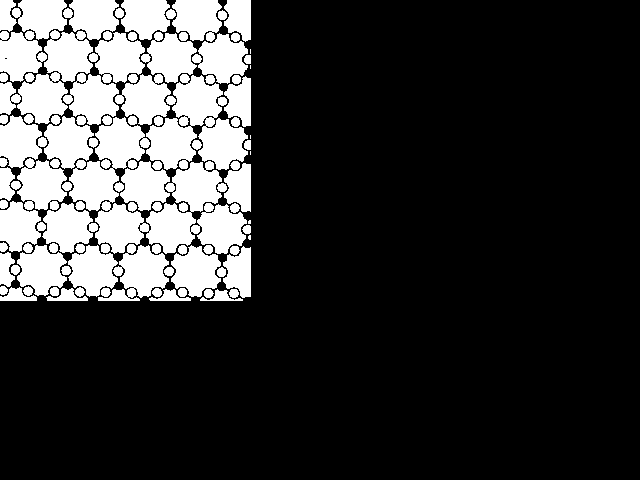
molecular arrangement in a crystal
A liquid has viscosity, a measure of its resistance to flow. The
viscosity of water at room temperature is about 0.01 poises. A thick oil might have
a viscosity of about 1.0 poise. As a liquid is cooled its viscosity normally
increases, but viscosity also has a tendency to prevent crystallisation. Usually
when a liquid is cooled to below its melting point, crystals form and it solidifies; but
sometimes it can become supercooled and remain liquid below its melting point
because there are no nucleation sites to initiate the crystallisation. If the
viscosity rises enough as it is cooled further, it may never crystallise. The
viscosity rises rapidly and continuously, forming a thick syrup and eventually an
amorphous solid. The molecules then have a disordered arrangement, but sufficient
cohesion to maintain some rigidity. In this state it is often called an amorphous
solid or glass.
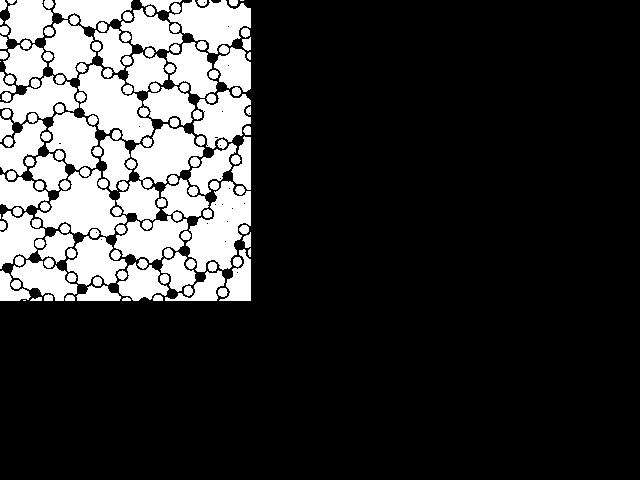
molecular
arrangement in a glass
Some people claim that glass is actually a supercooled liquid because there is no first
order phase transition as it cools. In fact, there is a second order
transition between the supercooled liquid state and the glass state, so a distinction
can still be drawn. The transition is not as dramatic as the phase change that takes
you from liquid to crystalline solids. There is no discontinuous change of density
and no latent heat of fusion. The transition can be detected as a marked change in
the thermal expansivity and heat capacity of the material.
The temperature at which the glass transition takes place can vary according to how
slowly the material cools. If it cools slowly it has longer to relax, the transition
occurs at a lower temperature and the glass formed is more dense. If it cools very
slowly it will crystallise, so there is a minimum limit to the glass transition
temperature.
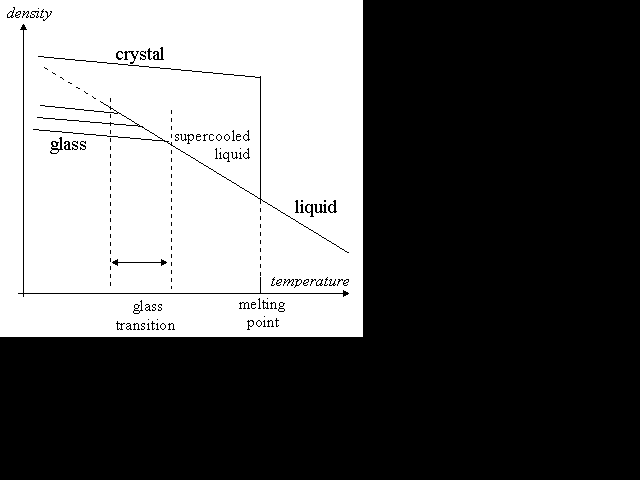
Density as a
function of temperature
in the phases of glassy materials
A liquid to crystal transition is a thermodynamic one; i.e. the crystal is
energetically more favourable than the liquid when below the melting point. The
glass transition is purely kinetic: i.e. the disordered glassy state does not have enough
kinetic energy to overcome the potential energy barriers required for movement of the
molecules past one another. The molecules of the glass take on a fixed but
disordered arrangement. Glasses and supercooled liquids are both metastable phases
rather than true thermodynamic phases like crystalline solids. In principle, a glass
could undergo a spontaneous transition to a crystalline solid at any time. Sometimes
old glass devitrifies in this way if it has impurities.
The situation at the level of molecular physics can be summarised by saying that there
are three main types of molecular arrangement:
- crystalline solids: molecules are ordered in a regular lattice
- fluids: molecules are disordered and are not rigidly bound.
- glasses: molecules are disordered but are rigidly bound.
[Just to illustrate that no such classification could ever be complete, recently
scientists have succeeded in making quasi-crystals that are quasi-periodic.
They do not fit into the above scheme and are sometimes described as being halfway between
crystals and glass.]
It would be convenient if we could conclude that glassy materials changed from being a
supercooled liquid to an amorphous solid at the glass transition, but this is very
difficult to justify. Polymerised materials such as rubber show a clear glass
transition at low temperatures but are normally considered to be solid in both the glass
and rubber conditions.
It is sometimes said that glass is therefore neither a liquid nor a solid. It has
a distinctly different structure with properties of both liquids and solids. Not
everyone agrees with this terminology.
Material properties of glasses
Usually when people talk about solids and liquids, they are referring to macroscopic
material properties rather than the arrangement of molecules. After all, glass as a
material was known about long before its molecular physics was understood.
Macroscopically, materials exhibit a very wide range of behaviours. Solids, liquids
and gases are ideal behaviours characterised by properties such as compressibility,
viscosity, elasticity, strength and hardness. But materials don't always behave
according to such ideals. For example, it's possible to take water from being a
liquid to a gas at high pressure without its passing through a phase transition; so at
some stage it must be between an ideal liquid and an ideal gas.
For crystalline substances the distinction between the solid and liquid states is very
clear, but what about glasses? Indeed, where do polymers, gels, foams, liquid
crystals, powders and colloids fit into this picture? Some people say that there is
no clear distinction between a solid and a liquid in general. A solid, they claim,
should just be defined as a liquid with a very high viscosity. They set an arbitrary
limit of 1013 poises above which they say it's a solid and below which it's a
liquid.
According to another point of view, this ignores a distinction between viscosity of
liquids and plasticity of solids. An ideal Newtonian liquid deforms at a rate which
is proportional to stresses applied and its viscosity. For arbitrarily small
stresses a viscous liquid will flow. Molasses, pine pitch and Silly Putty are
examples of liquids with very high viscosity which flow very slowly under only the force
of their own weight. On the other hand, plastics can be very soft but are still
considered solid because they have rigidity and do not flow.
Solids are elastic when small stresses are applied. They deform but return to
their original shape when the stress is removed. When higher stresses are applied
some solids break while others exhibit plasticity. Plasticity means that they deform
and don't return to their original shape when the stress is removed. Many substances
including metals such as copper have plasticity. The resistance to flow under
plastic deformation is called its viscoplasticity. This is like viscosity, except
that there's a minimum stress known as the elastic limit below which there is no
plasticity. Materials with plasticity do not flow, but they may creep, meaning they
deform slowly but only when held under constant stress.
So an arbitrary measure of viscosity or viscoplasticity is not a good way to
distinguish solids from liquids. Another way to define the distinction between solid
and liquid is to say that, if there is a minimum shear stress required to produce a
permanent deformation then it is a solid. This is just a precise way of saying it
has some rigidity. A liquid can then be defined as a material that will flow.
If it is placed in a container it will eventually flow to fill the lower reaches until its
own surface is flat. The difficulty is that these two definitions do not cover all
cases. There are materials that have some limited flow known as
viscoelasticity. The material will deform elastically under stress. If the
stress is held for a long time, the deformation becomes permanent even if the stress was
small. Materials with viscoelasticity may seem to flow slowly for a while but then
stop. It is futile to try to make a clear cut distinction between liquids and solids
in cases of such behaviour.
Types of Glass
To be sure that glass in old windows has not flowed, we need to recognise the
different properties of different glasses. Glass can be made from pure silica, but
fused silica has a high glass transition point at around 1200° C which makes it
difficult to mould into panes or bottles. At least 2000 years ago it was learned how
to lower the softening temperature by adding lime and soda before heating, which resulted
in a glass containing sodium and calcium oxides. Soda-lime glass used for windows
and bottles today contains other oxides as well. Measuring the glass transition
temperature for different glasses is not easy because it changes according to how slowly
the glass is cooled. In the case of modern soda-lime glass, a quick cooling will
produce a glass transition at about 550° C. There is thought to be a minimum
glass transition temperature at about 270° C, and if it is cooled very slowly it can
still be a supercooled liquid down to just above that temperature. Glass such as
Pyrex (used for test-tubes and ovenware) is usually based on boro-silicates or
alumino-silicates, which withstand heating better and typically have a higher glass
transition temperature. Some glasses, such as the leaded variety, have lower
transition temperatures.
Sometimes people say that good evidence that glass does not flow is provided by
telescope lenses which after 150 years still maintain excellent optical qualities.
They would be spoiled by the slightest deformation. In fact, optical glass is
usually not the same as the glass used in windows and bottles. It may be based on
boro-silicate or soda-lime glass with other metallic oxides added to improve its thermal
and optical properties. So old telescope lenses and mirrors provide good evidence
that some glasses do not flow, but little evidence to support the claim that glass in old
windows has not flowed. Another example is stone age arrow heads made of obsidian, a
natural glass. These are found to be still razor sharp after tens of thousands of
years, but again, this glass is mainly silica and alumino-silicates and is much tougher
than window glass.
For definitive evidence that glass has not flowed in old windows we must examine the
oldest examples. Early glass used to make bottles and windows was usually formed by
adding soda and lime to silicates. Sometimes potash was added instead. Usually
there were other impurities which made it softer than modern soda-lime glass. Other
compounds were often added to give colour or to improve its properties. The Romans
were making glass objects of this sort in the 1st century AD, and despite being very
delicate, some examples remain--such as the elaborately decorated Portland Vase kept at
the British Museum. Roman glassware provides some of the best available evidence
that types of soda-lime glass are not fluid, even after nearly 2000 years. The
oldest remaining examples of stained glass windows that remain in place have lasted since
the 12th century. The oldest of all are the five figures in the clerestory of
Augsburg Cathedral in Germany, which are dated to between 1050 to 1150. Many other
early examples are found in France and England including the magnificent North Rose window
of Notre Dame, Paris dating from 1250.
There have been many claims (especially by tour guides) that such glass is deformed
because the glass has flowed slowly over the centuries. This has become a persistent
myth, but close inspection shows that characteristic signs of flow, such as flowing
around, and out of the frame, are not present. The deformations are more consistent
with imperfections of the methods used to make panes of glass at the time. In some
cases gaps appear between glass panes and their frames, but this is due to deformations in
the lead framework rather than the glass. Other examples of rippling in windows of
old homes can be accounted for because the glass was imperfectly flattened by rolling
before the float glass process came into use.
It is difficult to verify with absolute certainty that no examples of glass flow exist,
because there are almost always no records of the original state. In rare cases
stained glass windows are found to contain lead which would lower the viscosity and make
them heavier. Could these examples deform under their own weight? Only careful
study and analysis can answer this question. Robert Brill of the Corning glass
museum has been studying antique glass for over 30 years. He has examined many
examples of glass from old buildings, measuring their material properties and chemical
composition. He has taken a special interest in the glass flow myth and has always
looked for evidence for and against. In his opinion, the notion that glass in
Mediaeval stained glass windows has flowed over the centuries is untrue and, he says,
examples of sagging and ripples in old windows are also most likely physical
characteristics resulting from the manufacturing process. Other experts who have
made similar studies agree. Theoretical analysis based on measured glass viscosities
shows that glass should not deform significantly even over many centuries, and a clear
link is found between types of deformation in the glass and the way it was produced.
Conclusion
There is no clear answer to the question "Is glass solid or liquid?". In terms of
molecular dynamics and thermodynamics it is possible to justify various different views
that it is a highly viscous liquid, an amorphous solid, or simply that glass is another
state of matter which is neither liquid nor solid. The difference is semantic.
In terms of its material properties we can do little better. There is no clear
definition of the distinction between solids and highly viscous liquids. All such
phases or states of matter are idealisations of real material properties.
Nevertheless, from a more common sense point of view, glass should be considered a solid
since it is rigid according to everyday experience. The use of the term "supercooled
liquid" to describe glass still persists, but is considered by many to be an unfortunate
misnomer that should be avoided. In any case, claims that glass panes in old windows
have deformed due to glass flow have never been substantiated. Examples of Roman
glassware and calculations based on measurements of glass visco-properties indicate that
these claims cannot be true. The observed features are more easily explained as a
result of the imperfect methods used to make glass window panes before the float glass
process was invented.

 نویسنده: حمید کیامیری